

This article is for general information purposes only and does not constitute legal, tax, or financial advice, nor a valuation in an individual case. Despite careful research, we assume no liability for accuracy, completeness, and timeliness. For specific questions, please consult a lawyer or tax advisor. Older content may be outdated due to changes in legislation or case law.
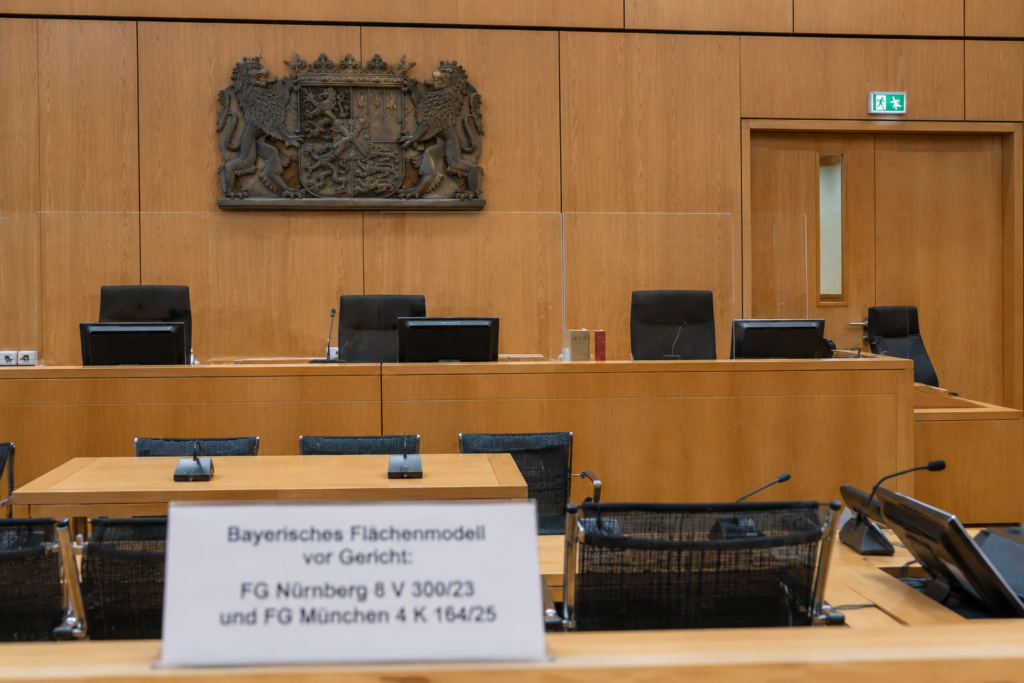
Bavaria is the only major German federal state to have introduced a property tax that is entirely independent of value: the Bavarian Property Tax Act (BayGrStG) assesses the tax solely on the basis of area, without taking into account land values, standard land values (Bodenrichtwerte), building fabric or market conditions. Two fiscal courts have found the model to be constitutional: the Nürnberg Fiscal Court rejected an application for suspension of enforcement in 2023 (case no. 8 V 300/23), and the Munich Fiscal Court confirmed the model on the merits in 2025 (case no. 4 K 164/25). Both cases are pending on appeal before the Federal Fiscal Court (BFH) (case nos. II R 33/25 and II R 40/25).
Overview of the Bavarian Area Model
The BayGrStG dispenses entirely with a value-oriented valuation. The tax assessment is based on:
- Equivalence amount for land: EUR 0.04 per square metre of land area
- Equivalence amount for buildings (commercial): EUR 0.50 per square metre of building area
- Equivalence amount for buildings (residential): EUR 0.35 per square metre of building area (a 30 percent discount).
Neither the standard land value (Bodenrichtwert) nor location, age of construction, energy efficiency or building fabric are factored into the calculation. Regular general revaluations (Hauptfeststellungen) are not provided for. The model is therefore particularly simple and stable from an administrative standpoint – but it is criticised for distributing the tax burden without regard to the property's actual economic capacity.
FG Nürnberg 8 V 300/23 of 8 August 2023: Suspension of Enforcement Rejected
In the first relevant fiscal court proceeding, the owner of several properties applied for suspension of enforcement of his property tax assessment (Section 69 (3) of the Fiscal Court Code, FGO), on the grounds that he considered the BayGrStG unconstitutional.
The Nürnberg Fiscal Court rejected the application. It found no serious doubts as to the constitutionality of the BayGrStG. The court based its decision on the following considerations: the legislature has broad discretion in choosing the valuation standard. The rationale for the property tax is the possibility of using the infrastructure provided by the municipality. The land area appropriately reflects this benefit – larger areas typically make more intensive use of and place greater demands on municipal infrastructure. The decision to dispense with a location component was a deliberate political choice made by the legislature and does not constitute a constitutional violation.
FG München 4 K 164/25 of 13 August 2025: Action Dismissed on the Merits
The Munich Fiscal Court was the first German fiscal court to rule on the merits regarding the Bavarian Area Model, dismissing an action brought by a property owner. The appeal, which was granted, is now pending before the BFH (case no. II R 40/25).
The official guiding principles state:
"The provisions of the BayGrStG for determining the equivalence amounts for property tax B are formally and substantively constitutional, and in particular do not violate the principle of equality."
"The design of property tax B as a value-independent area model falls within the discretionary scope of the Bavarian legislature."
The court based this on the equivalence principle: property tax is an object-related tax that is not linked to individual economic capacity but to the possibility of using municipal infrastructure. Larger plots of land and buildings can typically make more extensive use of this infrastructure – making an area-based assessment appropriate. The fact that wealthy owners in prime locations (Nürnberg city centre, Munich urban area) and less affluent owners in peripheral locations are charged the same tax per square metre is acceptable within the scope of permissible typification. Article 8 BayGrStG provides a waiver mechanism for cases of hardship.
Pending BFH Appeals and Outlook
Both Bavarian fiscal court rulings have triggered appeals to the BFH (case no. II R 33/25 for FG München 4 K 702/23, case no. II R 40/25 for FG München 4 K 164/25). An oral hearing before the BFH is unlikely to take place before 2027. Until the Federal Fiscal Court renders its decision, owners have the option of filing an objection to their property tax assessments and applying for a stay of proceedings pursuant to Section 363 (2) sentence 2 of the German Fiscal Code (AO), provided the appeal is recognised as a test case.
Significance for Valuation Practice
For real estate valuers and tax advisors in Bavaria, the area model initially represents a relief: a complex market value determination is not required for property tax purposes. Nevertheless, appraisal reports remain relevant when owners seek a waiver under Article 8 BayGrStG or when the property tax burden needs to be taken into account in purchase price or income approach calculations. Until the BFH renders its decision, the constitutionality of Bavarian property tax law remains in limbo – an aspect that should be considered in property purchases and portfolio valuations.