



This article is for general information purposes only and does not constitute legal, tax, or financial advice, nor a valuation in an individual case. Despite careful research, we assume no liability for accuracy, completeness, and timeliness. For specific questions, please consult a lawyer or tax advisor. Older content may be outdated due to changes in legislation or case law.
On 10 April 2018, the Federal Constitutional Court ruled that the unit valuation of real property for property tax purposes has been unconstitutional at least since 2002. The system, based on main assessment values from 1964, had led to such massive value distortions that the principle of equality could no longer be upheld. The decision forced the legislature to completely redesign the property tax system – and thus marked the starting signal for the 2019 Property Tax Reform Act and the new property tax regime from 2025.
Starting point: unit valuation since 1964
Property tax was based on unit values that were last assessed for West Germany as of 1 January 1964 (for the new federal states, values from 1935 applied). A periodic main assessment, which was actually supposed to take place every six years, was discontinued from 1964 onwards. For decades, the unit values were merely updated according to rigid formulas, without regard to market developments.
The result: in metropolitan areas and growth regions, land values rose many times over, while in rural areas price development was significantly more moderate. At the same time, the 1964 valuation system was entirely unable to reflect structural changes – energy efficiency, housing quality, locational differentiation. Properties with nearly identical unit values could have market values that differed by orders of magnitude.
Facts and Underlying Proceedings
The Federal Constitutional Court had several joined proceedings before it: three referrals for judicial review from the Federal Fiscal Court (BFH) (case nos. 1 BvL 11/14, 1 BvL 12/14, 1 BvL 1/15) as well as two constitutional complaints from property owners (case nos. 1 BvR 639/11, 1 BvR 889/12). In the lead case 1 BvL 11/14, a plaintiff had acquired a developed property in Berlin for which the tax office continued to apply a unit value assessed in 1964. The BFH stayed the proceedings and referred the question to the Federal Constitutional Court as to whether the continued unit valuation was compatible with the Basic Law (Grundgesetz).
Operative Provisions
The Federal Constitutional Court (First Senate) ruled: the provisions of the Valuation Act (Bewertungsgesetz) on unit valuation of real property in the old federal states are, at least since 1 January 2002, incompatible with Art. 3 para. 1 of the Basic Law (GG). The legislature was obliged to enact new legislation by 31 December 2019 at the latest. After promulgation of new legislation, the old rules could still be applied for a maximum of five further years, but no later than until 31 December 2024.
Key statements on valuation reality
The court formulated a general principle for valuation rules:
"If valuation rules generally do not allow for a valuation that is realistic in its relative terms, not even the avoidance of ever so significant administrative burden justifies their use. Nor does the low amount of a tax justify the use of such unrealistic valuation rules."
What matters is not whether an individual property happens to be correctly valued, but whether the system in its relative terms is realistic. The abandonment of regular main assessments removes a system-sustaining element: property tax law necessarily presupposes periodic revaluations. Without them, the valuation system inevitably develops into a "dysfunctional" system that produces unequal treatment on an ever-increasing scale.
The court further clarified:
"The suspension, since 1964, of the periodic main assessment originally provided for under unit valuation law inevitably leads, in the case of property tax, to an increasing degree of unequal treatment through value distortions which, at least since 2002, are justified neither by the administrative burden avoided through new main assessments, nor by the low amount of the individual tax burden, nor by considerations of practicability."
The 2019 Property Tax Reform as the legislature's response
On 29 November 2019, the Property Tax Reform Act (Grundsteuerreformgesetz, GrStRefG) entered into force, together with an amendment to the Basic Law (Art. 72 para. 3 sentence 1 no. 7 GG) introducing a state opt-out clause (Länderöffnungsklausel). Key features:
Federal model (11 federal states): Revaluation of all properties as of the reference date 1 January 2022 using a value-based model (a standardized income approach for residential properties, a cost approach for non-residential properties, in each case incorporating standard land values [Bodenrichtwerte]). Property tax liability under the new law applies from 1 January 2025.
State opt-out clause: Bavaria, Baden-Württemberg, Hamburg, Hesse and Lower Saxony made use of the option to enact their own state property tax legislation. The models chosen range from a pure area-based model (Bavaria) through a modified land value model (Baden-Württemberg) to an area-factor model with a locational component (Hesse).
Current developments
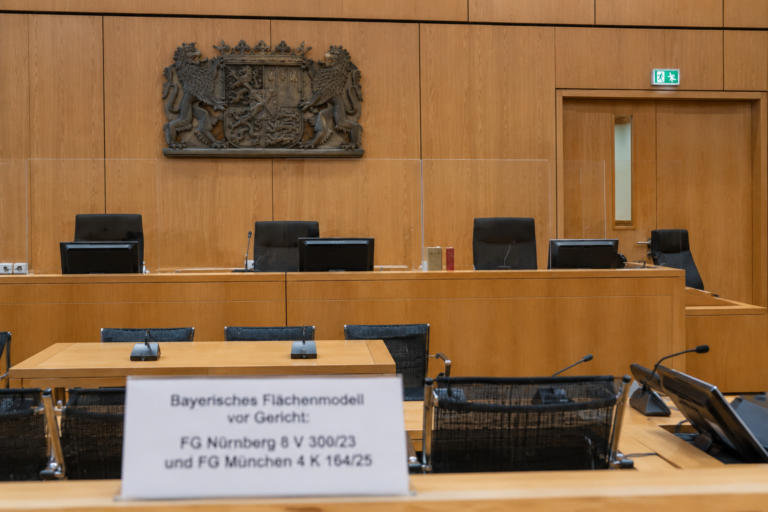
By rulings of 10 December 2025 (case nos. II R 25/24 et al.), the Federal Fiscal Court (BFH) classified the federal property tax model as constitutional. The case law of the fiscal courts (FG) on the state models has likewise predominantly found them constitutional; the BFH confirmed the Baden-Württemberg land value model by ruling of 20 May 2026 (case nos. II R 26/24 and II R 27/24). BFH appeals are pending for Bavaria, Hamburg and Hesse. Constitutional complaints against the federal model have been announced before the Federal Constitutional Court (BVerfG) – the proceedings have therefore not yet been concluded at the constitutional court level.
Significance for real estate valuers
The 2018 ruling shows that the Constitutional Court does not measure valuation systems against the precision of individual values, but against the realism of the system in terms of the relationship between assets. Even though the new property tax values are standardized and generalized, they must, on the whole, reflect actual value relationships.
In practice, this means: valuers who review property tax values for plausibility or prepare expert opinions in objection proceedings are working in a constitutionally sensitive area. The corridor doctrine known from 1 BvL 10/02 (±30% for mass procedures) also applies to the new property tax law – and both the BFH and the BVerfG will be measured against this standard.