

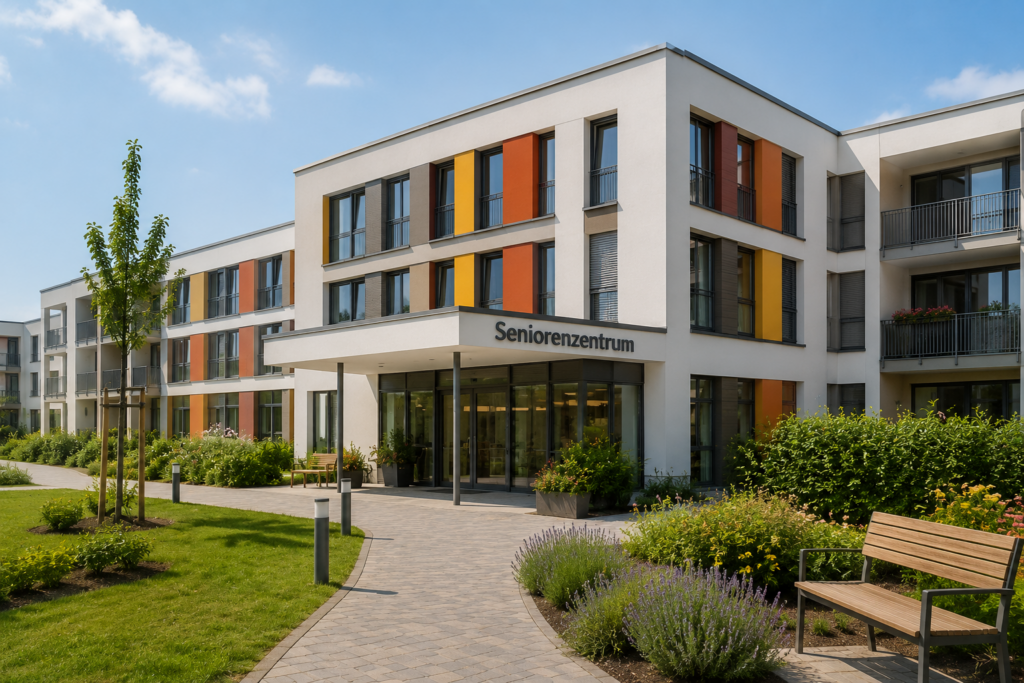
Social real estate – nursing homes, assisted living facilities, daycare centers, disability and integration care facilities, or homeless assistance facilities – are among the most complex valuation objects. The reason: Their value depends not primarily on location, size, and year of construction, but on whether a sustainable operation can be run permanently with the property. Anyone wishing to have a social real estate property valued therefore needs an appraisal report that understands the property as a operator-run property and not as an ordinary residential or commercial property.
The core issue: With a social real estate property, investors are not buying walls, but a cash flow from a regulated operation. The key questions are therefore: How secure is the rent/lease, how solid is the operator – and what is the building worth if the operation ceases?
Why the Income Approach is Central
Social real estate properties are almost exclusively leased or rented out and held for income generation. Thus, the income capitalisation approach income approach is the leading method according to the ImmoWertV. The starting point is the sustainably achievable rent or lease payment – for nursing homes typically as an operator lease based on a long-term lease agreement, often with terms of 20 to 25 years and indexation.
Unlike with residential real estate, this lease payment cannot be derived from a rent index. It results from the refinancing capacity of the operation: For nursing homes, these are the revenues achievable through care rates and investment cost reimbursement under SGB XI; for daycare centers and integration care, the fees and public funding. A lease payment that the operator cannot permanently generate from the operation is worthless for valuation purposes, no matter how high it may be stated in the contract.
The Three Value-Determining Factors
1. Operator Creditworthiness and Lease Coverage Ratio
The security of the cash flow depends entirely on the operator. Creditworthiness, track record, the number of facilities operated, and above all the rent coverage ratio – the ratio of operating income generated to the contractual rent. If it is significantly above 1, the location can cover the rent even during occupancy dips; if it is close to 1, every fluctuation in occupancy poses a risk.
2. Location and Demand Analysis
For care and social real estate, it is not the classic residential location quality that matters, but the demographic demand in the catchment area: care rate, competitive density, waiting lists, and municipal needs planning. A care home in a structurally weak region with a declining population can carry significant vacancy and thus income risk, despite being in good condition.
3. Alternative Use Potential
The most important safety buffer in the appraisal report is the question: What happens if the operator fails? A modern care home with a high proportion of single rooms and flexible floor plans can be re-leased or repurposed. A specialized building with small wet rooms, double rooms, and special fittings is practically only usable for this specific purpose – the alternative use potential is low, and the property should be assessed accordingly as risk-laden. This is reflected in the property yield rate and the assumed remaining useful life.
Legal and Regulatory Framework
Social real estate operates within a dense regulatory framework that directly affects valuation: the Residential and Care Contract Act (WBVG), the respective state care home laws with their minimum structural standards (such as single room quotas), the Social Code (SGB XI and XII), and funding-related restrictions. State-level tightening of room standards can make existing care homes in need of renovation or conversion overnight – a risk that a careful appraisal report identifies and assesses.
Special Features of Supported Housing, Kindergartens, and Inclusion Facilities
Assisted living or service housing lies between a classic residential property and an operator-dependent property: The apartments are generally suitable for third-party use, whereas the care contract is operator-dependent. Day-care centers and inclusive facilities rely on long-term contracts with municipal or independent providers; here, the creditworthiness of the public sector and the contract term are the decisive factors for the security of the income. In all cases, the following applies: The more a property is tailored to a single purpose, the more important it becomes to separately assess the income value and the liquidation value of the land.
Conclusion
Valuing a social property means analyzing a regulated operation, a lease agreement, and a specialized building simultaneously. A reliable market value appraisal combines the income analysis with a sober assessment of operator creditworthiness, demand, and third-party usability – thereby making it transparent how much of the value depends on the ongoing operation and how much the substance carries even in a default scenario.
The Real Estate Valuer office STRECKEL prepares market value appraisals for care properties, assisted living, and social facilities – for investors, operators, municipalities, and the public sector. Book a non-binding consultation now.
⚖ Legal Framework
Regulatorische Angaben – insbesondere Landesheimrecht und Refinanzierungsregeln – wurden zum Veröffentlichungszeitpunkt geprüft; maßgeblich ist das jeweils aktuelle Landes- und Bundesrecht.