


This article is for general information purposes only and does not constitute legal, tax, or financial advice, nor a valuation in an individual case. Despite careful research, we assume no liability for accuracy, completeness, and timeliness. For specific questions, please consult a lawyer or tax advisor. Older content may be outdated due to changes in legislation or case law.
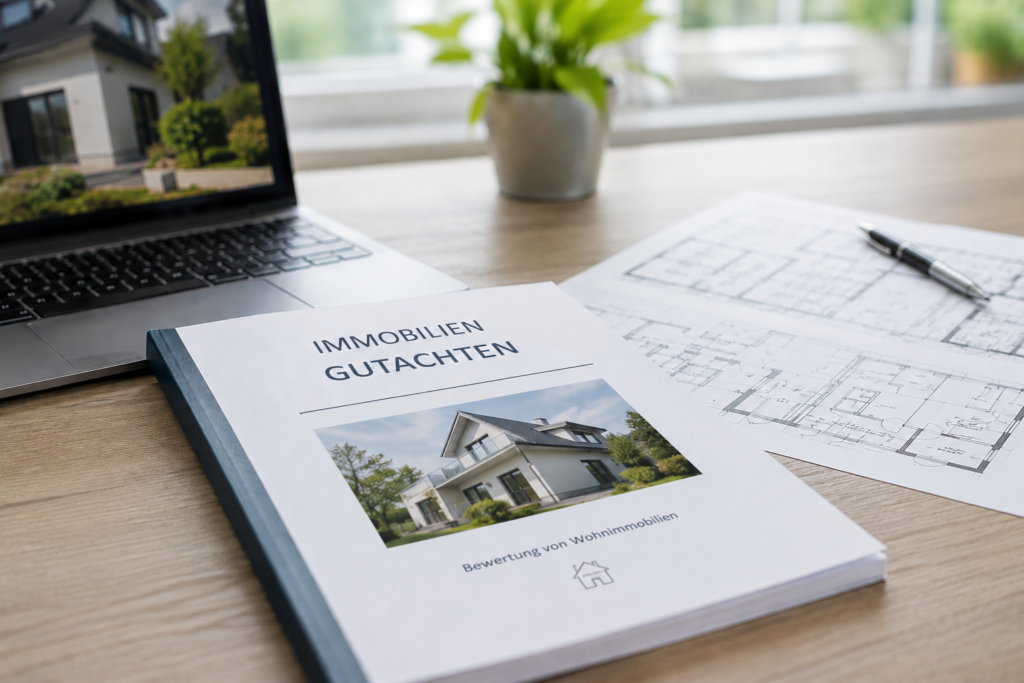
For inheritance tax purposes, the tax office determines the property value automatically using a standardized procedure pursuant to §§ 182 et seq. of the German Valuation Act (Bewertungsgesetz, BewG). In practice, this value is often higher than the actual market value – an independent appraisal report can correct it by providing proof of a lower fair market value (§ 198 BewG).
How does the tax office calculate?
Depending on the type of property, the tax office applies one of three standardized (typified) procedures:
- Sales comparison approach for condominiums and single-/two-family houses, provided suitable comparable prices from the expert committees (Gutachterausschuss) are available.
- Income approach for rented multi-family houses and income-producing properties.
- Cost approach, when no comparison or income data are available, often the case with individual or older buildings.
These procedures work with standardized land value benchmarks, construction year factors, and typified valuation figures. Individual particularities such as renovation backlog, noise pollution, unfavorable layout, or third-party rights are barely or not at all taken into account – this regularly results in an excessively high tax value.
The way out: proof of the lower fair market value
§ 198 BewG grants heirs and beneficiaries the right to prove to the tax office a lower actual market value. The following are recognized for this purpose:
- an appraisal report from the competent expert committee (Gutachterausschuss), or
- an appraisal report by a publicly appointed and sworn valuer or a valuer certified for real estate valuation according to DIN EN ISO/IEC 17024.
A purchase price from an actual sale, commissioned shortly after the inheritance case, can also serve as proof.
Is an appraisal report worthwhile?
Whether the effort is worthwhile depends on the ratio between the appraisal costs and the tax savings. In cases of deviations of 15–30% between the tax office's value and the actual market value – for example due to modernization needs or unfavorable plot layouts – the tax savings generally clearly exceed the cost of the appraisal report. An early assessment by us provides clarity here before the tax assessment becomes final and binding.