

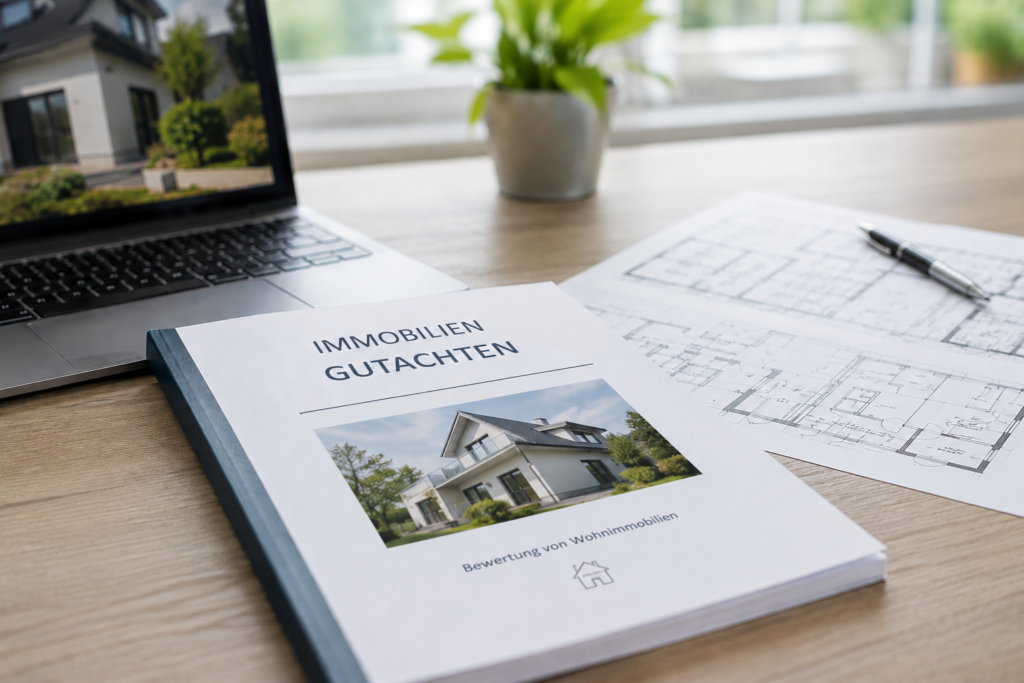

How is a condominium unit valued and what should be considered regarding separate property?
Condominiums are usually valued using the sales comparison approach. In addition to the flat itself, the co-ownership share in the common property, special usage rights, and the structural condition of the entire building are factored into the valuation.
Read detailed answerWhat special aspects apply when valuing a multi-family house?
Multi-family houses are generally valued using the income approach, whereby all rental income, vacancies, and operating costs are considered jointly for the entire building.
Read detailed answerHow is a commercial property valued?
Commercial properties are usually valued using the income approach, whereby the remaining terms of lease agreements, tenant creditworthiness, third-party usability, and the location within the commercial context play a central role.
Read detailed answerHow does a partial ownership unit, such as a parking space or a commercial unit within a homeowners' association, affect the valuation?
Partial ownership (Teileigentum) is valued similarly to residential condominium ownership, but taking the differing type of use into account. Parking spaces and commercial units within condominium owners' associations follow their own comparison criteria and rent levels.
Read detailed answerHow is a holiday property or weekend house valued?
Holiday properties are valued using either the sales comparison approach or the income approach, depending on use. In the case of tourist letting, achievable income from short-term rentals as well as seasonal fluctuations must also be taken into account.
Read detailed answerHow is a new building valued before completion?
A new building before completion is valued on the basis of the construction planning, the construction progress and the costs already incurred as well as those still outstanding, usually supplemented by an estimate of the anticipated value upon completion.
Read detailed answerWhat role does a construction defect play in the valuation?
Identifiable structural defects lead to a discount equal to the expected cost of remediation. In the case of serious defects affecting structural stability, the value may be reduced significantly more than the pure repair costs.
Read detailed answerHow is an agriculturally used property valued?
Agricultural land is usually valued using the sales comparison approach for arable or grassland, supplemented by separate values for farmsteads, buildings and any special crops or tenancy arrangements.
Read detailed answerHow does the WEG's maintenance reserve affect the value of a condominium unit?
A well-funded maintenance reserve tends to have a value-enhancing effect, as upcoming renovations are already financially provided for. A low reserve, on the other hand, can indicate future special assessments and therefore a discount.
Read detailed answerWhat is the difference between market value and replacement value (insurance value)?
The replacement value reflects the cost of restoring a building to its original condition in the event of damage, and forms the basis for building insurance. The market value additionally takes into account the land, location and market conditions.
Read detailed answerHow is a property with contamination or hazardous substances valued?
In the case of suspected contaminated sites, the unencumbered value is first determined and then reduced by the estimated remediation and investigation costs as well as an uncertainty discount for the remaining marketing risk.
Read detailed answerWhat role does the remaining useful life of a building play in valuation?
The remaining useful life describes the period during which a building can continue to be used economically under ordinary maintenance. It significantly influences both the age-related depreciation in the cost approach and the multiplier in the income approach.
Read detailed answerHow does a heritable building right (Erbbaurecht) in favor of third parties affect a neighboring property?
Easements such as rights of way, pipeline, or crossing rights in favor of third parties restrict the usage possibilities of the encumbered property and reduce its value in proportion to the extent of the impairment.
Read detailed answerHow is a listed commercial property valued?
In the case of listed commercial properties, increased renovation costs and limited conversion options are weighed against possible tax depreciation benefits and a particular locational attractiveness for certain user groups.
Read detailed answerWhat is a special use area and how is it valued?
Special usage areas such as gardens, terraces, or parking spaces within a homeowners' association are available for exclusive use by one owner, but legally remain part of the common property. They are taken into account with their own, usually moderate, value premium.
Read detailed answerHow does planned densification in the surrounding area affect the market value?
Specifically planned new construction projects in the neighborhood can have either a value-enhancing or value-reducing effect, depending on their nature – for example, through improved infrastructure on the one hand, or shading, noise, and increased density on the other.
Read detailed answerHow is a property with building-permit uncertainty, such as an unauthorised construction (Schwarzbau), valued?
Unauthorized structures are generally valued with a significant deduction, as subsequent approval or an official order for demolition cannot be reliably ruled out.
Read detailed answerHow is the market value of a property calculated?
The market value is determined in accordance with the German Real Estate Valuation Ordinance (ImmoWertV) using one of three standardized methods: the sales comparison approach, the income approach, or the cost approach. Which method is applied depends on the type of property, its use, and the available data.
Read detailed answerWhat is the difference between market value and purchase price?
The market value is an objectively determined, expert-substantiated value pursuant to § 194 BauGB (German Building Code). The purchase price is the price actually negotiated between two parties, which can deviate depending on negotiating skill, market conditions at the time of sale, and individual motives.
Read detailed answerWhat is the standard land value and how does it affect the market value?
The standard land value is an average location value per square meter of undeveloped building land, published annually by the expert committee (Gutachterausschuss). It forms the basis for land value determination and thus a key component of the market value.
Read detailed answerWhich factors reduce the market value of a property?
Value-reducing factors include, among others, a backlog of renovations, outdated building technology, an unfavorable floor plan layout, noise or odor pollution, third-party rights such as rights of residence, and poor energy efficiency. We take these factors into account through deductions in the valuation process.
Read detailed answerHow often should the market value of a property be reassessed?
There is no fixed deadline – however, an existing appraisal report should be updated at the latest in the event of significant market changes, major structural work, or if it is more than one to two years old.
Read detailed answerWhat is the difference between market value and mortgage lending value?
The mortgage lending value is determined by banks conservatively and independently of short-term market fluctuations, in order to secure the credit risk. It is usually 10 to 20 percent below the market value, which reflects the realistically achievable market price.
Read detailed answerHow does an existing tenancy affect the market value?
Let properties are usually valued using the income approach and, due to limited owner-occupation potential, often achieve a lower market value than a comparable vacant property – particularly in the case of long-term leases below market level.
Read detailed answerWhat is the sales comparison approach?
In the sales comparison approach, the value of a property is derived from actual purchase prices achieved for comparable, already sold properties. It is particularly suitable for condominiums and single-family houses with sufficient comparable data.
Read detailed answerWhat is the income approach?
The income approach determines the value of a property based on the sustainably achievable rental income less operating costs, capitalized using a land interest rate (Liegenschaftszinssatz). It is used primarily for let multi-family houses and commercial properties.
Read detailed answerWhat is the cost approach?
The cost approach determines the value based on the building's construction costs, less depreciation for age, plus the land value. It is applied when there are insufficient comparable prices or rental income available, for example in the case of individually used single- and two-family homes.
Read detailed answerHow does a leasehold right (Erbbaurecht) affect the market value?
In the case of a heritable building right (Erbbaurecht), the building is valued separately from the land, since the holder of the heritable building right does not acquire ownership of the land. The remaining term, the ground rent (Erbbauzins), and reversion (Heimfall) provisions significantly influence the value.
Read detailed answerWhat role does the energy condition play in the market value?
Energy efficiency is becoming increasingly important in valuation: a poor energy standard leads to discounts due to foreseeable renovation costs, while a high energy standard or a current energy performance certificate can have a value-enhancing effect.
Read detailed answerHow does the micro-location influence the property value?
The micro-location – i.e. the immediate surroundings of a property – often has a stronger impact on value than the general city location. Factors such as neighboring buildings, noise, view, or proximity to infrastructure are decisive.
Read detailed answerWhat is meant by the property interest rate (Liegenschaftszinssatz)?
The standard land interest rate (Liegenschaftszinssatz) describes the market-standard rate of return on the capital tied up in the land and is derived by the expert committees (Gutachterausschuss) from actual sales transactions. It is a key input variable in the income approach.
Read detailed answerCan the market value be determined retroactively for a past valuation date?
Yes, a retrospective valuation is possible and is often even necessary in cases of inheritance, divorce, or tax matters. The valuer reconstructs the market conditions and the structural condition as of the respective reference date.
Read detailed answerWhat effect does heritage protection have on market value?
Heritage protection has an ambivalent effect: imposed renovation obligations and restricted conversion options often reduce value, while tax depreciation benefits and the special character of some properties can increase value.
Read detailed answerWhat is the difference between Verkehrswert and market value of a property?
Market value (Verkehrswert) and market value (Marktwert) are legally synonymous – both refer to the price that could be achieved for a property in the ordinary course of business. The term "Verkehrswert" is legally defined in § 194 BauGB, while "Marktwert" is the internationally common technical term with the same meaning.
Read detailed answerNo results
No question matches these filter criteria.