

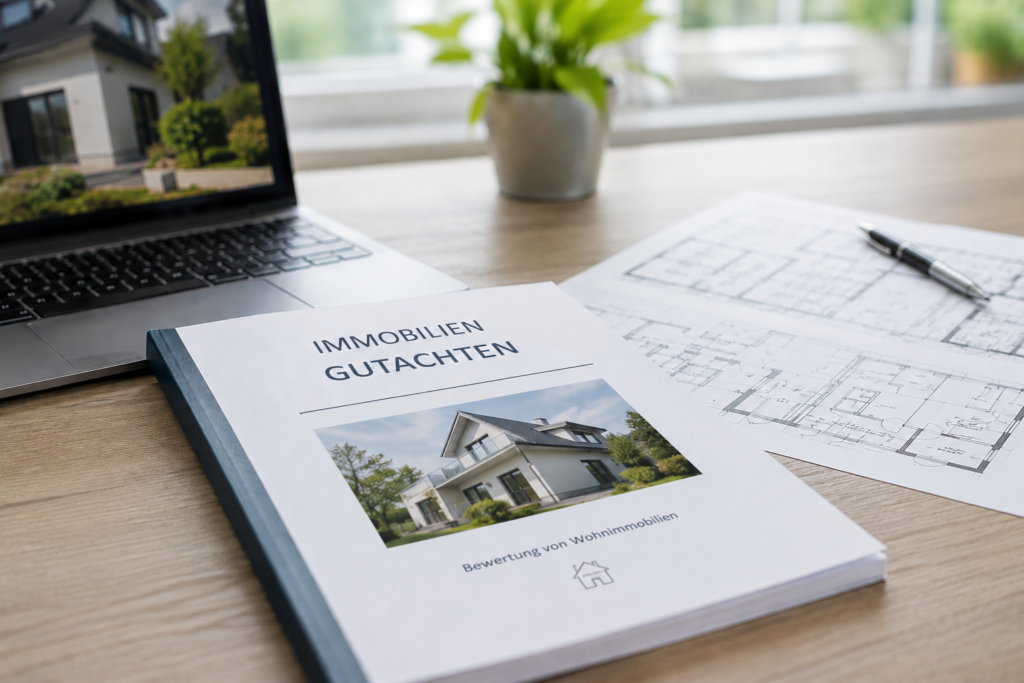


The valuation of a property is not limited to the analysis of location, plot size, year of construction or fittings. Equally decisive are the legal framework conditions associated with the ownership. Of particular importance here are the rights of third parties entered in the land register. In particular, residential rights and usufruct rights can significantly affect the market value of a property, as they restrict the owner's options for use and disposal.
In practice, such encumbrances regularly lead to uncertainties – both for owners and prospective buyers. It is not uncommon to assume that the value of a property can be reduced by a fixed percentage as soon as a right of residence or usufruct is registered. In reality, however, the valuation is carried out in a much more differentiated manner. The type, scope and duration of the respective right play a role, as do the individual characteristics of the property and the current market situation.
Right of residence and usufruct – two different legal positions
Although both rights are often considered together, they differ considerably both legally and economically.
The right of residence in rem pursuant to § 1093 BGB (German Civil Code) entitles a person to inhabit a property or a specific part of it for life or for a limited period. This right is generally personal in nature and can neither be sold nor inherited. Likewise, renting out by the entitled party is generally excluded, unless otherwise agreed.
Usufruct pursuant to Sections 1030 et seq. of the German Civil Code (BGB) goes considerably further. The usufructuary is not only entitled to use the property personally but is generally also entitled to let it and to collect all income derived from it. From an economic perspective, during the term of the usufruct the owner is often left with only the so-called "bare ownership," as the rights of use lie entirely with the beneficiary.
It is precisely these differences that have a direct impact on the market value. A lifelong right of usufruct regularly constitutes a stronger economic burden than a simple right of residence.
Why such rights reduce the market value
The market value of a property is based on the price that can be achieved under normal market conditions. In this respect, actual usability plays a central role.
If a property cannot be used by the owner due to a registered right of residence, the pool of potential buyers is significantly reduced. For owner-occupiers, purchasing is often not an option if the property cannot be occupied for an indefinite period. Investors also tend to be more cautious in valuing such properties if little or no rental income can be generated.
In the case of usufruct, the effects are often even more pronounced. Since the beneficiary is entitled to all uses, the owner has neither personal use nor ongoing rental income available. This considerably restricts the economic availability of the property.
This reduced usability has a direct impact on marketability. The smaller the pool of potential buyers, the more difficult marketing often becomes, and the greater the impact this can have on the achievable purchase price.
The valuation is not carried out on a flat-rate basis
A common misconception is to value residential rights or usufruct rights with a fixed discount on the property value. In fact, there are no flat-rate percentages for this.
Rather, within the scope of a professional market value determination, the economic value of the registered right is calculated. This is based on various factors that must be considered individually for each property.
These include, in particular:
- the age of the beneficiary,
- the statistically expected remaining life expectancy,
- the amount of a market-standard rent,
- the scope of the right granted,
- any cost arrangements,
- as well as the specific entry in the land register.
Based on this data, the capitalized value of the right of residence or usufruct is determined. Recognized financial mathematical methods as well as the multipliers published annually by the Federal Ministry of Finance are applied for this purpose. Only afterwards can the impact of the right on the market value of the property be reliably determined.
Differences between right of residence and usufruct in valuation
Even though both rights appear similar, there are considerable differences in their valuation.
With a residential right, economic use is often excluded. The encumbrance is essentially limited to the personal use of the affected rooms. Under certain conditions, other parts of the building can continue to be rented out or used.
With usufruct, however, all uses of the property are attributed to the beneficiary. They may live in the property themselves, rent it out, or otherwise exploit it economically. As a result, the reduction in value is regularly higher than with a comparable right of residence.
For this reason, it is necessary in every real estate valuation to carefully analyze the specific structure of the registered right. Even minor differences in the land register can have a significant impact on the market value.
Effects on sale and financing
Not only the calculated market value is affected by residential rights or usufruct. The actual sales process is often also more challenging.
Many prospective buyers are looking for a property for their own use and are therefore ruled out at an early stage. This often significantly extends the marketing period. At the same time, demand is more strongly concentrated on investors or buyers with a long-term investment horizon.
Lending institutions also take existing land register rights into account when financing. Since encumbered properties can, under certain circumstances, be more difficult to sell in the event of a realisation, rights of residence and usufruct are regularly factored into the determination of the mortgage lending value. Depending on how they are structured, this can have an impact on financing options.
Significance for gifts, inheritance and anticipated transfer of assets
Right of residence and usufruct play an important role not only in property sales. They are frequently agreed upon in the context of anticipated succession.
For example, parents transfer their home to their children during their lifetime while simultaneously securing a lifelong residential right or usufruct right for themselves. In this way, ownership can be transferred at an early stage without having to forgo the use of the property.
It is precisely in these cases that a proper real estate valuation is of particular importance. The value of the registered right not only affects the market value of the property but can also play an important role in tax-related matters.
Conclusion
Residential rights and usufruct are among the most significant land register encumbrances in German real estate law. They affect the economic marketability of a property and have a direct impact on its market value. A professional real estate valuation therefore takes into account not only location, condition and fittings, but also analyzes the legal framework conditions and their economic consequences.
Since the nature, scope and duration of such rights vary from case to case, flat-rate value deductions cannot be determined in a serious manner. Only an individual valuation that takes into account all property- and market-relevant factors enables a reliable determination of the market value and creates transparency for owners, buyers and financing banks.